Authors: Bramble Gardiner and Lisa Howard
We share results from collaborative research exploring the experiences of and impacts on people engaged to be community food researchers (CFRs) within FoodSEqual. The research was part of a PhD at the University of Plymouth (supervisors: Dr Clare Pettinger, Louise Hunt and Mary Hickson).
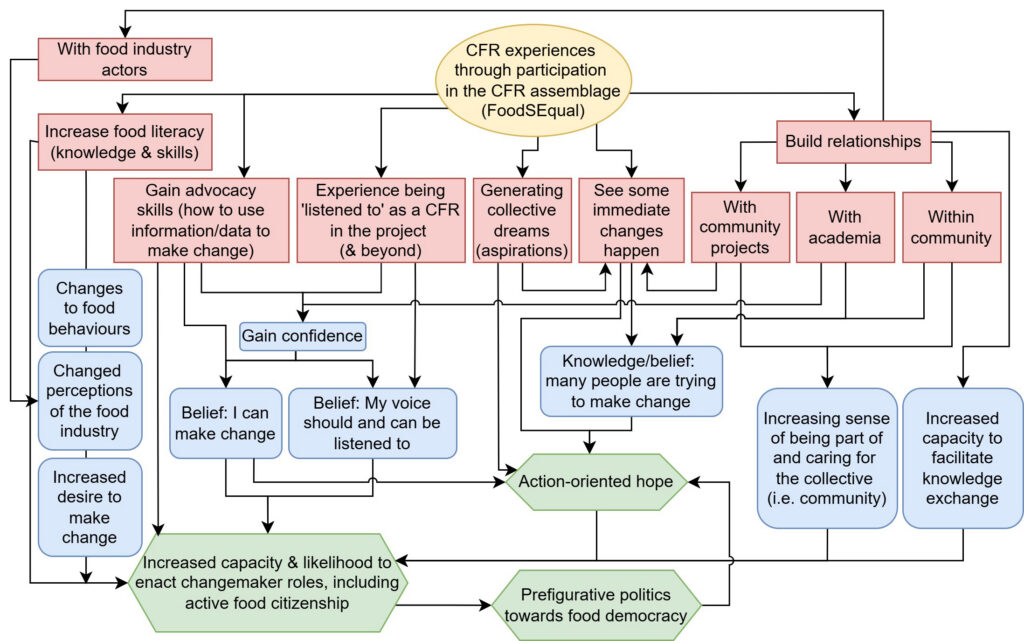
We found co-production can support development of action-oriented hope alongside skills and capacities for making change. We argue these are important contributions towards food systems transformation, particularly the development of food citizenship. See mechanisms via which capacities emerge in figure 1, and more in the published article.
“it’s about working together…. and the outcomes from that. Like a new work lifestyle, and love and acting on hope, which is a tricky one to explain how safety, trust, tolerance, lots of different things, which is about community, which is bigger than the food system… being a part of a really healthy community all around” – Community Food Researcher
However, to unlock such potential and mitigate risks it’s necessary to deliver participation well. During FoodSEqual the community coordinators (particularly Lisa Howard) organised a reflective section with the support of academics and FoodSEqual budget to facilitate Community Food Researchers’ time and attendance. The results of this (published here) identified the process as contributing towards social and community capitals, and produced recommendations for delivery of participatory research (see below) alongside two major reflection points:
- Community collaborator roles include significant additional relational and emotional work, the extent of which is not always recognised by non-community collaborators.
- Community participants often raise important topics in unstructured time, there needs to be resource for such unstructured time in research designs; alongside flexible budget that can be used to follow up on the topics raised.
Consolidated recommendations for designing and delivering participatory research or co-production identified in this research:
- Project designs and methods should:
- engage appropriate collaborators embedded in the community
- take into consideration how community partners are set up, and how the research project will be embedded
- consider multiple ways to appropriately value and reward participation, and maximise such benefits
- incorporate multiple recruitment options for activities
- include space/budget for unstructured activities and unplanned outcomes
- include fun!
- should not be finalised without sufficient community partner input.
- Training should include:
- experiential learning experiences (for community and non-community partners)
- capacity building for non-community collaborators to challenge assumptions and understand community ways of working
- supporting community collaborators to consider implications of their ‘insider’ role, including their own boundaries around privacy.
- Delivery:
- working in smaller groups makes co-production easier and quicker (can subdivide for specific tasks)
- collectively piloting methods is a key tool
- work with community collaborators to create and deliver context appropriate communication
- communication within teams is as important as external communications, and should use varied methods
- academics should ask ‘what do you think we should do’?
- sufficient time for feedback, reflection, and learning is essential
- process-focused co-production activities should be included (for example, mapping collaborator strengths/assets).
- Additional work to undertake community roles should be recognised and valued.